Slewing bearings play a vital role in various industries, providing rotational movement and stability to large-scale machinery and equipment. Understanding what slewing bearings are and their significance is essential for businesses looking to optimize their operations. In this comprehensive guide, we will delve into the world of slewing bearings, exploring their functionality, types, applications, and benefits. By the end of this article, you will have a solid understanding of slewing bearings and their importance in the industrial landscape.
Definition of Slewing Bearing
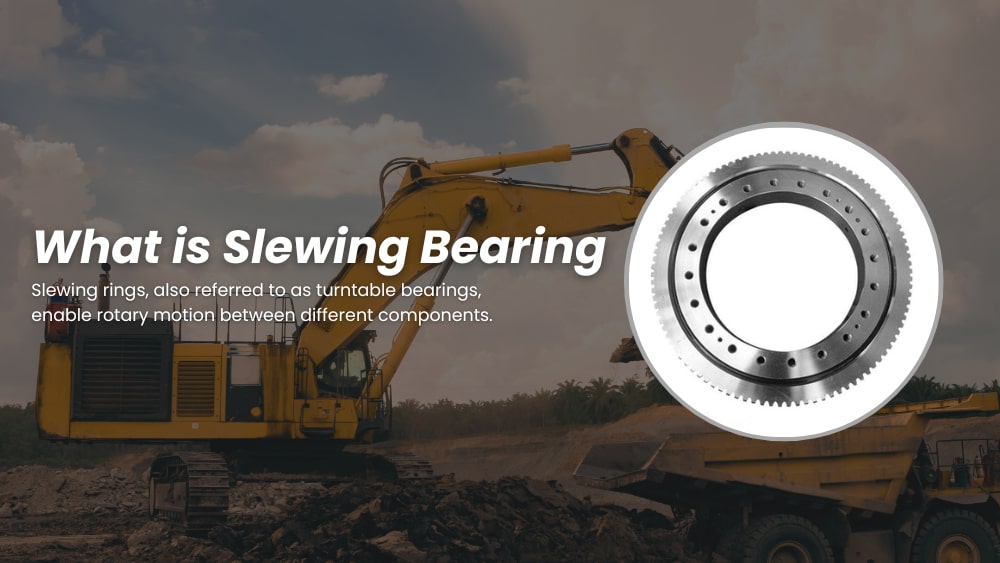
Slewing bearings, also known as slewing rings or turntable bearings, are large-diameter bearings designed to handle axial, radial, and moment loads. They enable rotational movement between two components, such as a shaft and a fixed structure, while supporting heavy loads and providing stability. Slewing bearings are crucial for machines that require smooth and controlled rotation, allowing them to operate efficiently and safely.
What Are the Types of Slewing Bearings?
The most common types include:
Single Row Ball Slewing Bearings: These bearings consist of a single row of balls mounted in a raceway, providing low friction rotation and excellent axial and radial load capacity.
Double Row Ball Slewing Bearings: These bearings have two rows of balls for higher load-carrying capacity and greater stability.
Crossed Roller Slewing Bearings: These bearings use cylindrical rollers arranged in a crossed configuration for high rigidity, precision, and shock resistance.
Three-Row Roller Slewing Bearings: These bearings have three rows of rollers and are ideal for handling heavy loads and moments.
Slewing Bearings in Industrial Applications
Construction and Heavy Machinery
In the construction and heavy machinery industries, slewing rings are widely used in excavators, cranes and concrete pumps.
wind power generation
The renewable energy sector relies heavily on slewing bearings for wind turbine applications. These bearings enable the rotation of the turbine blades, ensuring optimal wind capture and power generation.
Material Handling Equipment
Slewing bearings are widely used in material handling equipment, including conveyors, stackers and cranes.
Robotics and Automation Equipment
In robotics and automation, slewing bearings are used in robotic arms, turntables and other motion control systems.
Benefits of Slewing Bearings
excellent carrying capacity
These bearings can accommodate axial and radial loads, making them suitable for applications requiring heavy-duty performance. Additionally, slewing rings provide rotational precision, ensuring smooth and accurate movement even under heavy loads.
takes up minimal space
Its compact design allows efficient integration into machines and plants, optimizing space utilization. Additionally, slewing rings help reduce weight and increase energy efficiency by providing load carrying capacity in a relatively lightweight design.
can save costs
These bearings can withstand harsh operating conditions and require minimal maintenance. By minimizing downtime and reducing the need for frequent repairs, businesses can experience increased productivity, increased reliability and cost-effective operations.